

The Pilot-First Mandate: Why Rapid AI Pilots Are a Governance Tool, Not Just a Speed Tactic
Ask most pharma executives why they run AI pilots, and you will get some version of the same answer: speed. Pilots let you test an idea fast, prove value, and move on before the market shifts underneath you. That is true, but it’s not the most important reason to run one.
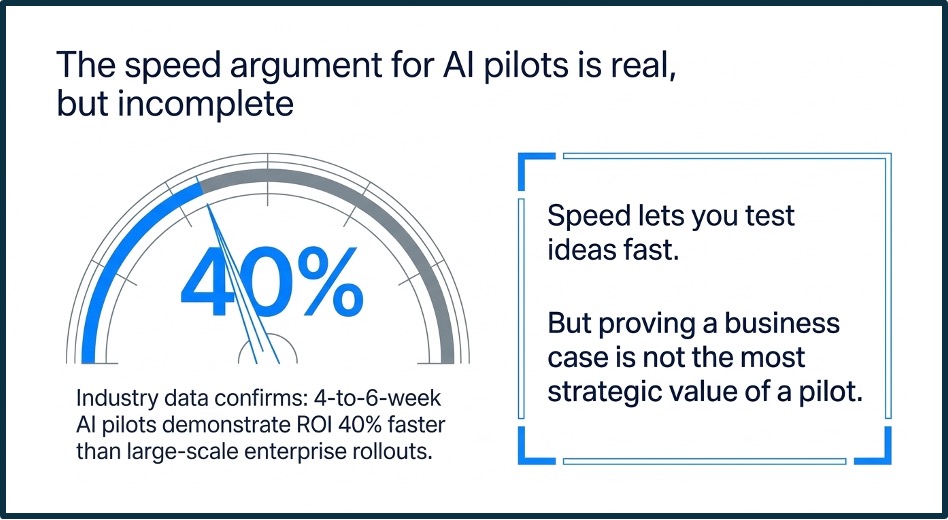
A recent DIA Global Forum article on clinical AI investment made a point worth sitting with: four-to-six-week pilots demonstrate ROI 40% faster than large-scale rollouts. That’s a compelling speed argument. But the more strategic value of a pilot isn’t how fast it proves a business case – it’s how cheaply it lets you find the cracks in your governance model before they become expensive, contractual, and hard to undo.
Pilots Reveal What Vendor Demos Never Will
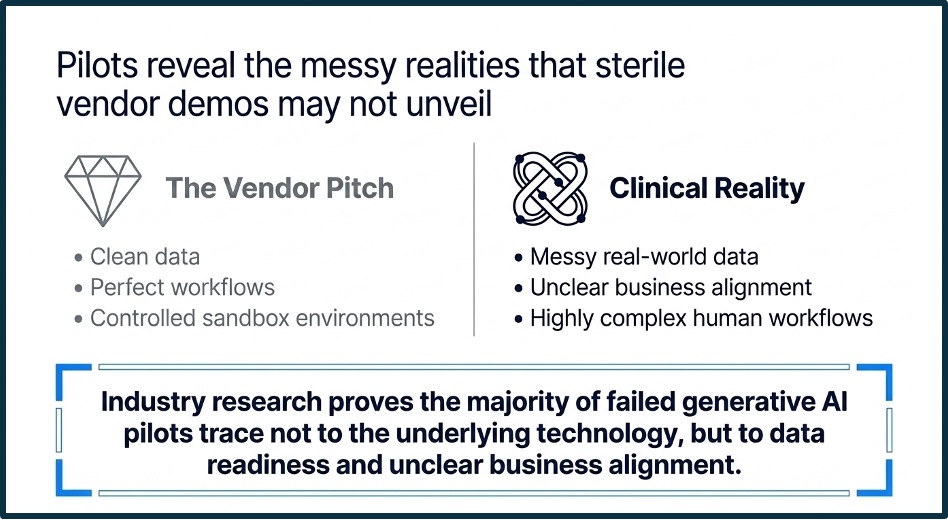
Every AI vendor pitch looks clean. Every case study shows the tool working exactly as intended, on someone else’s data, in someone else’s environment. The gap between that pitch and your reality only shows up once real data, real workflows, and real people touch the system.
That gap is often larger than expected. Industry research has found that a majority of failed generative AI pilots trace not to the underlying technology, but to data readiness and
The “Big Bet” Trap
There’s a natural pull toward big commitments in pharma. Enterprise procurement cycles favor large, defensible decisions over a string of small experiments, and it can feel more efficient to skip straight to scale. But committing to enterprise-wide deployment before pilot data exists doesn’t just risk picking the wrong tool, it risks locking in governance gaps at scale, at the exact moment when fixing them becomes hardest.
This is especially true anywhere generative AI touches regulatory submissions, medical coding, or patient-facing decisions. Human-in-the-loop design with clear review checkpoints, explainability standards, and documented accountability isn’t a concession to caution. It’s a competitive differentiator, and one that is far easier to build into a small pilot than to retrofit into a live enterprise system.
Designing a Pilot That Tests Governance, Not Just Function
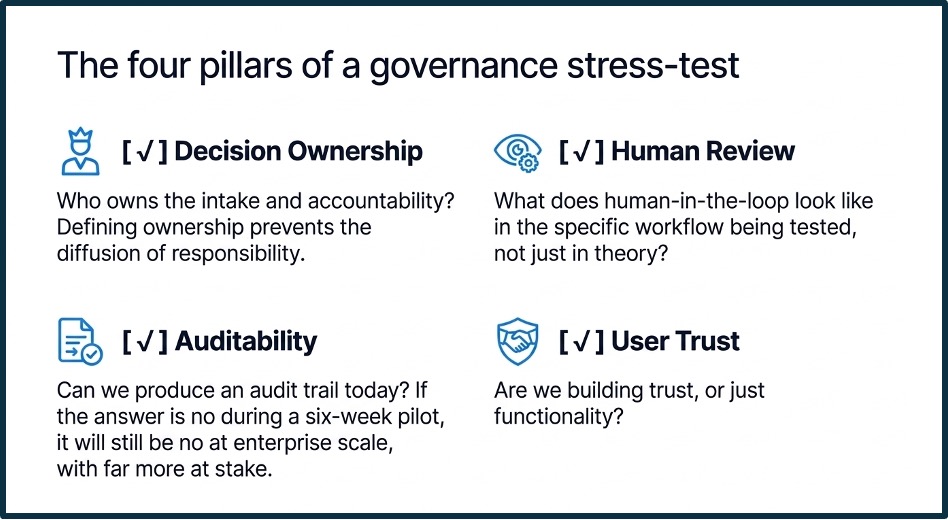
If your pilots are only measuring whether a tool “works,” they are only doing half the job. A well-designed pilot should also be answering:
- Who owns this decision? Clear intake and accountability, even at pilot scale, prevents the diffusion of responsibility that undermines so many well-intentioned AI initiatives.
- What does human review actually look like here? Not in theory but in the specific workflow you are testing.
- Can we produce an audit trail today? If the answer is no during a six-week pilot, it will still be no at enterprise scale, just with far more at stake.
- Are we building trust, not just functionality? A tool can perform well technically and still fail to gain adoption if the people using it don’t trust how it’s governed.
That last point matters more than it might seem. Industry data consistently shows that clinical innovations take years to fully implement, in large part because adoption – not deployment – is the real bottleneck. A pilot that tests governance alongside function can also test the conditions for adoption: Do end users trust the oversight in place? Do they understand how decisions get reviewed? Change management and governance are not separate workstreams; in a well-run pilot, they are tested together.
Governance as R&D
It’s worth reframing what a pilot is actually for. It is not just a procurement shortcut or a way to de-risk a budget line. It is governance research and development – a structured, low-stakes environment to discover what oversight, review, and accountability need to look like before they are scaled across an organization, a therapeutic area, or a portfolio of trials.
Companies that treat pilots this way tend to make a quieter but more durable kind of progress. They are not the ones announcing the biggest AI investment of the year. They are the ones who, two or three years from now, have governance frameworks mature enough to move quickly and confidently into whatever comes next because they built that muscle six weeks at a time.
The fog around AI investment in pharma will not clear through bigger bets; it clears through disciplined, small ones that are designed not just to prove a tool works, but to prove you know how to govern it.
For a deeper look at what durable AI governance requires in practice, see BioData’s paper on AI governance in biopharma.